
티스토리 뷰
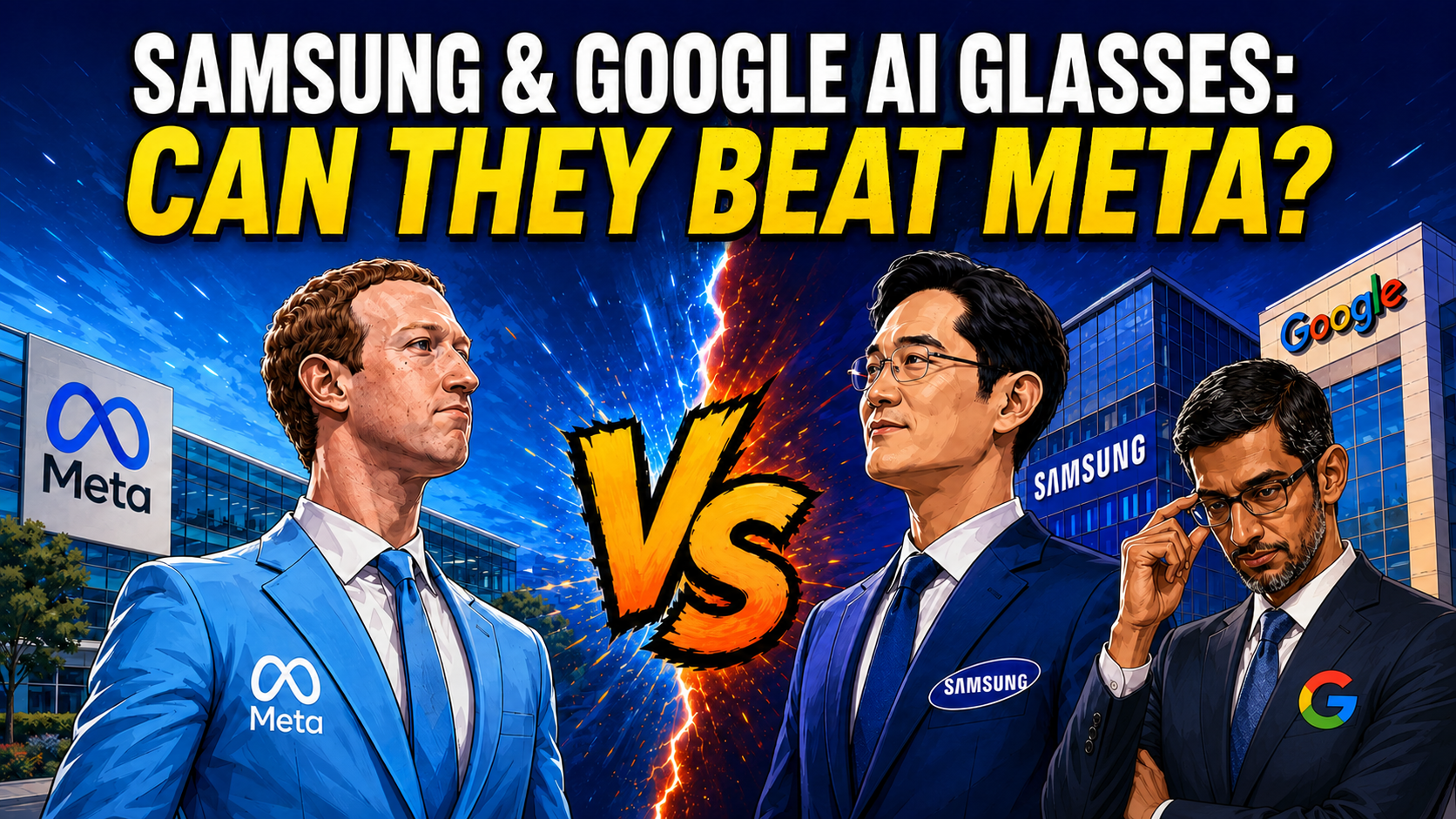
Right now, Meta is sitting comfortably at the top of the AI glasses market.
Recent reports suggest that the company holds around 80% of the global smart glasses market, largely thanks to the success of Ray-Ban Meta.
In other words, Meta is not just winning.
It is currently playing the game almost by itself.
But that may not last forever.
Samsung and Google are preparing to enter the market with their own AI glasses, expected sometime in the second half of 2026.
With Android XR, Gemini, and Samsung’s hardware experience behind them, these glasses could become one of Meta’s most serious challengers yet.
So here is the big question.
Can Samsung and Google finally slow Meta down?
Or will Meta simply put on another pair of Oakleys and keep walking?
What Exactly Are AI Glasses?

Some people imagine AI glasses as the device that will finally send smartphones into retirement.
That sounds exciting.
It is probably also a little too early.
Today’s AI glasses are better understood as companions to your phone, not replacements for it.
Think about everything your smartphone already does.
It takes photos, makes calls, sends messages, searches the web, translates languages, gives directions, and answers almost any question through AI.
The problem is not that smartphones are incapable.
The problem is that you have to keep taking them out of your pocket.
And unless you plan to walk around holding your phone in front of your face all day, that can become annoying.
Glasses are different.
They are already sitting on your face.
That small difference could completely change how we use technology.
Imagine taking a photo with only your voice.
Sending a message without touching your phone.
Getting directions while walking through a new city.
Or looking at a building and asking, “What is that?”
That is what AI glasses are trying to do.
They are not here to steal your phone’s job.
They are here to make it stop working overtime.
Where Will the Real Battle Happen?
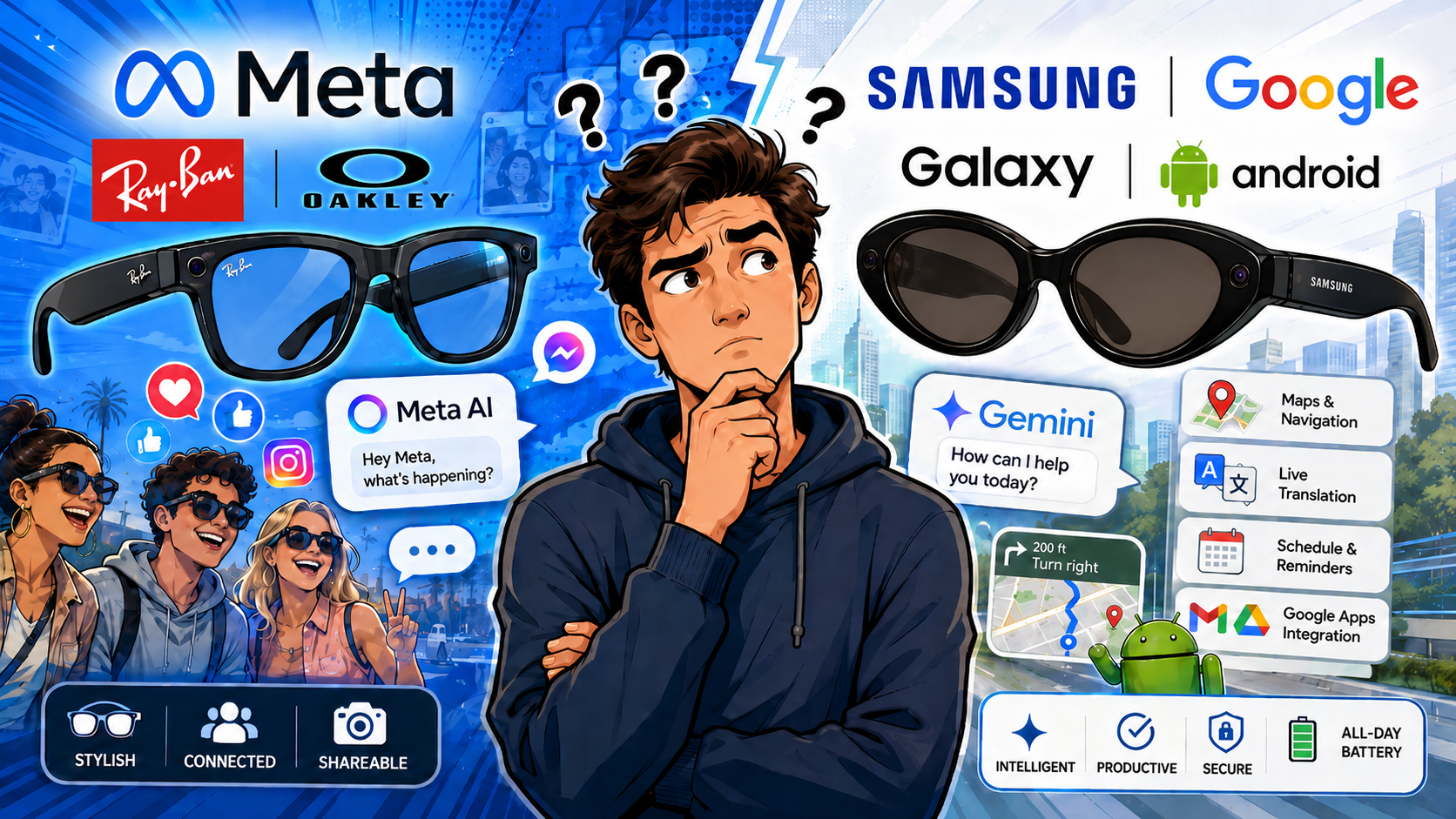
When people compare AI glasses, they usually start with the hardware.
The camera.
The speakers.
The battery.
The chipset.
And yes, all of those things matter.
Nobody wants smart glasses with a blurry camera, weak sound, or a battery that gives up before lunch.
But Meta, Samsung, and Google are all working within the same general limits of today’s technology.
Their cameras, speakers, processors, and batteries may end up being more similar than we expect.
So the real battle may come down to three things.
How the glasses look.
What ecosystem they connect to.
And, most importantly, the AI living inside them.
Let’s take a closer look.
Design Matters More Than You Think
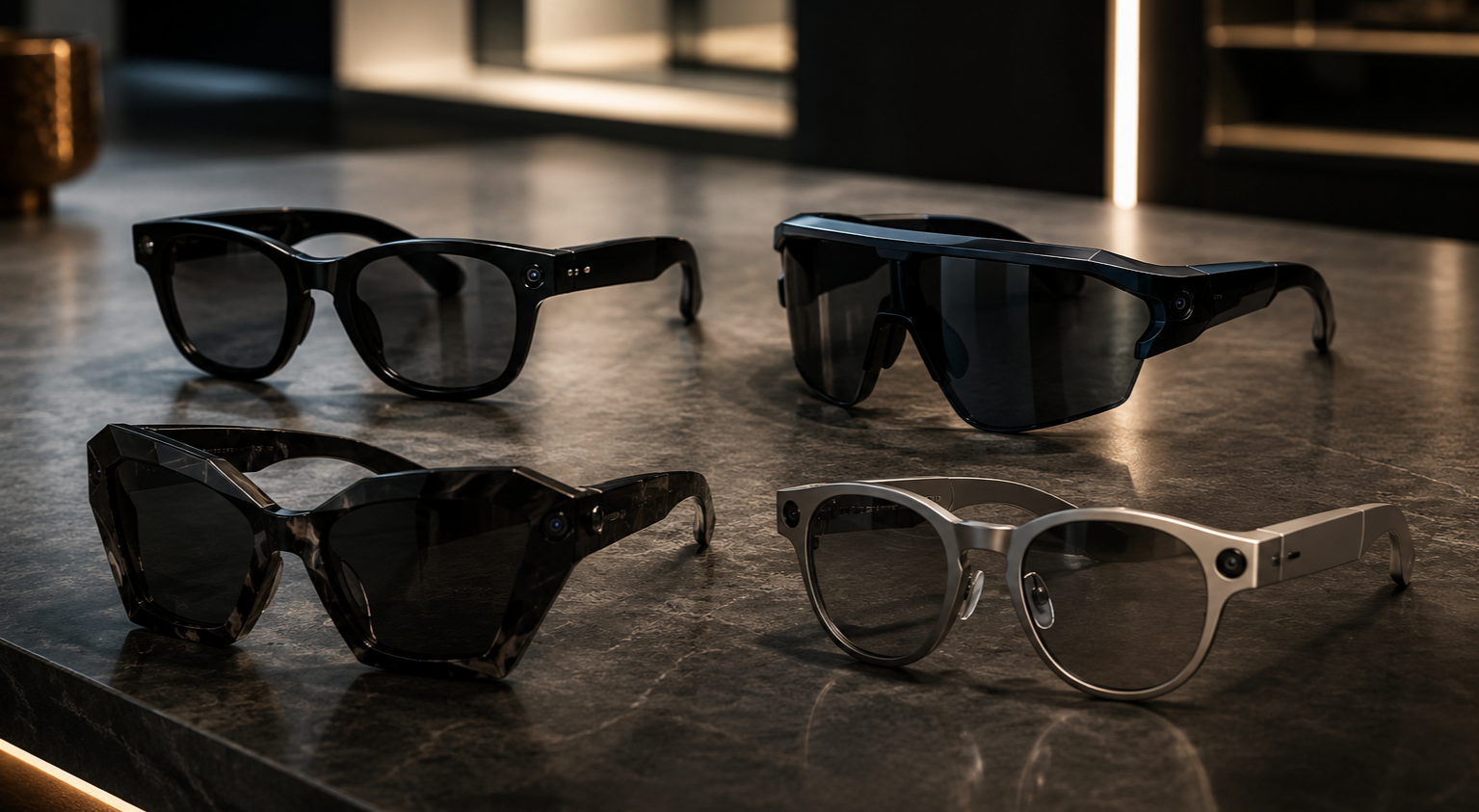
One of Meta’s smartest decisions had almost nothing to do with artificial intelligence.
It chose Ray-Ban.
Later, it added Oakley.
That may sound like a simple branding decision, but it solved one of the biggest problems with wearable technology.
People do not want to look like they are wearing a computer on their face.
They want to look good.
Preferably without appearing as if they have just escaped from a science-fiction convention.
Meta understood that early.
Samsung and Google seem to understand it too.
Instead of building another bulky futuristic gadget, they have partnered with eyewear brands such as Gentle Monster and Warby Parker.
Each brand brings a completely different personality.
Ray-Ban feels classic and familiar. Its frames already look natural in everyday life.
Oakley feels sporty and performance-focused. It makes more sense for cycling, running, outdoor activities, and people who enjoy looking fast even when standing still.
Gentle Monster is bold, experimental, and fashion-forward. Its glasses are not shy, and they are definitely not trying to disappear into the background.
Warby Parker feels modern, clean, and approachable. Its designs are simple without looking boring or overly futuristic.
This is not just a fashion contest.
Design may decide whether people see AI glasses as useful technology, an awkward gadget, or something they actually want to wear every day.
Because if nobody wants to put your glasses on their face, it does not really matter how intelligent they are.
Android XR vs Meta’s Ecosystem
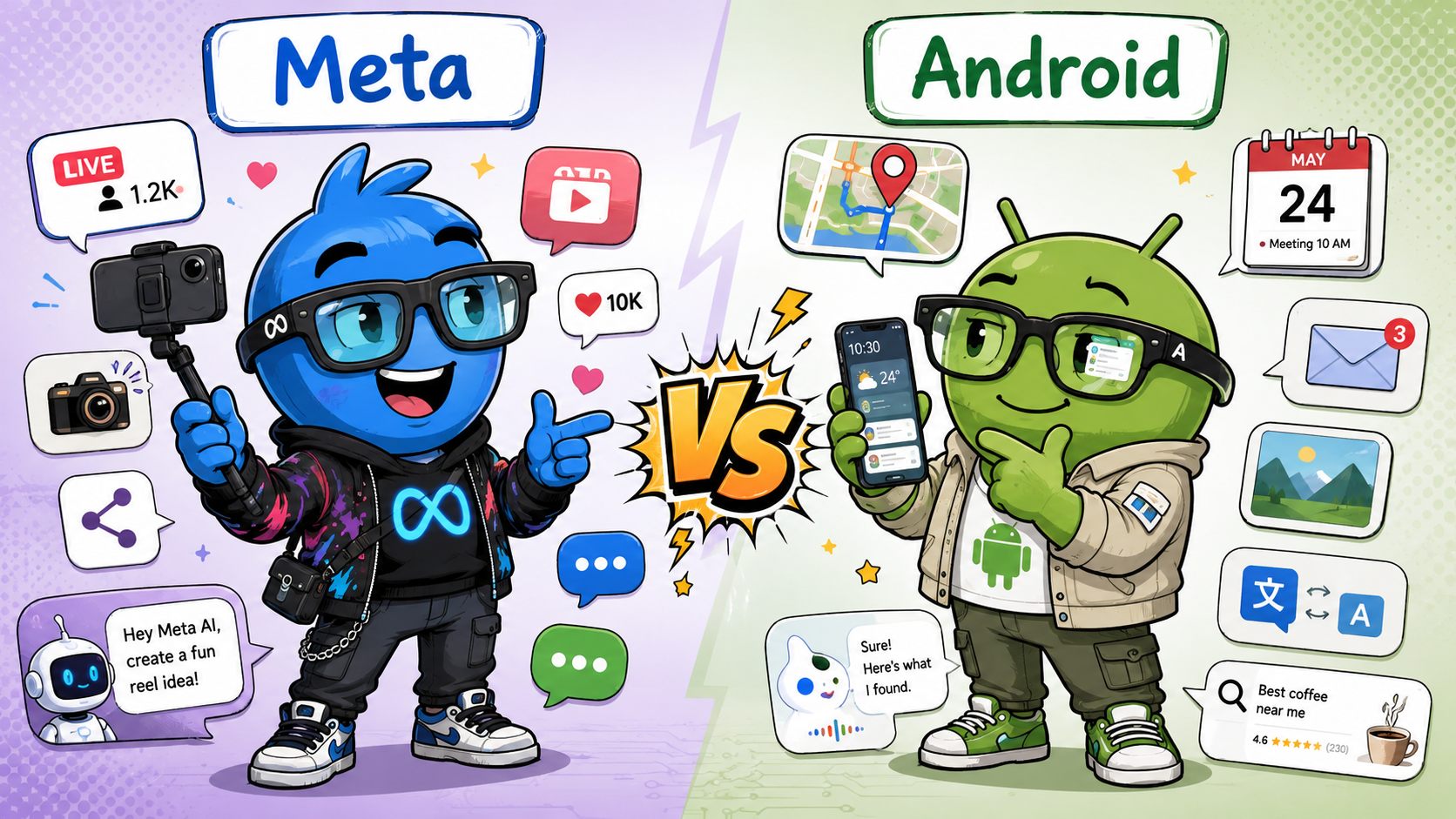
This could become one of the biggest differences between the two sides.
Meta already has a head start when it comes to communication and social sharing.
Meta glasses support hands-free calls and messages through services such as WhatsApp and Messenger. During supported video calls, you can even show the other person what you are seeing through the glasses.
Some models and regions also support livestreaming to Instagram and Facebook.
Samsung and Google are taking a different approach.
Their future glasses are expected to run on Android XR and Gemini. They could eventually connect with Android smartphones, Galaxy devices, and familiar Google services such as Maps, Gmail, Calendar, YouTube, and Photos.
If Samsung and Google can bring these services together smoothly, Android users may not feel like they are learning a completely new device.
If Google services are already part of your daily life, that familiarity could become one of Samsung and Google’s biggest advantages.
Meta AI vs Gemini

Meta AI and Gemini are both powerful, but they seem to have very different personalities.
Meta’s strength comes from its social world.
Facebook, Instagram, Messenger, and WhatsApp are places where people talk, share photos, follow trends, send questionable memes, and keep up with friends.
That could make Meta AI feel more casual, creative, and socially aware.
It might help you write a funny caption, suggest an idea for a short video, understand what you are looking at, or simply have a more natural conversation.
Inside smart glasses, Meta AI could feel like a trendy friend who is always ready to join the conversation and help you share the moment.
Gemini feels a little different.
Its strength comes from Google’s huge ecosystem of information and everyday tools, including Search, Maps, Gmail, Calendar, YouTube, and Photos.
That could make Gemini especially useful when you need to find information, organize your schedule, get directions, summarize something, or complete a task quickly.
Inside smart glasses, Gemini may feel less like the friend who sends you memes and more like the friend who somehow remembers your schedule, finds the restaurant, translates the menu, and tells you which train to take.
In other words, the useful friend.
Neither approach is necessarily better.
They simply focus on different parts of our lives.
Meta AI may feel like a creative friend who understands your social world.
Gemini may feel like a very capable assistant that helps you get things done.
One helps you enjoy and share the moment.
The other helps make sure you actually arrive on time.
Should You Buy Meta Now or Wait for Samsung?
If you are thinking about buying AI glasses, there is no single answer for everyone.
It depends on what you care about most.
Choose Meta’s glasses if...
You want one of the most established AI glasses available today.
You like Ray-Ban or Oakley designs.
You do not want to wait several more months.
You prefer a product that has already been used by millions of people.
You mainly want to share content more easily.
Most importantly, you want something you can actually buy now.
Wait for Samsung and Google if...
You already use an Android or Galaxy smartphone.
You rely heavily on Google Maps, Gmail, Calendar, Photos, or YouTube.
You are especially interested in Gemini.
You prefer Gentle Monster or Warby Parker designs.
You want to see how deeply AI glasses can connect with the Android and Google ecosystem.
Meta is currently the safer choice because its glasses already exist, work, and have proven that people are willing to buy them.
Samsung and Google are still the uncertain option.
Their glasses could be amazing.
They could also arrive later than expected, cost more than expected, or make us wait through several dramatic launch events before we can actually buy them.
Still, if your digital life already lives inside Android and Google services, waiting may be worth it.
Final Thoughts
Meta has experience.
Samsung and Google have an enormous ecosystem.
Meta already knows how to build, market, and sell successful AI glasses.
Samsung and Google know how to create hardware, software, and services used by billions of people every day.
Samsung may not defeat Meta immediately.
But it could push Meta to move faster, improve its AI, lower prices, and give users more choices.
And honestly, that may be exactly what this young market needs.
The real winner may be the company that makes AI glasses feel completely ordinary.
In the not-so-distant future, people will simply put them on and leave the house.
Just like normal glasses.
Except these ones may remind you about your meeting, translate a street sign, take a photo, and politely judge you for getting lost again.
'AI Glasses' 카테고리의 다른 글
| Oakley Meta HSTN: How to Turn Your Golf Buddy Into an Unpaid Cameraman (0) | 2026.06.28 |
|---|---|
| Oakley Meta Vanguard: Can It Replace GoPro for Cyclists? (0) | 2026.06.28 |
| Meta Glasses by Kylie: Rise and Shine, Kylie’s in Your Glasses (0) | 2026.06.27 |
| Ray-Ban Meta AI Glasses: Free Your Hands and Stay Present (0) | 2026.06.26 |
- Total
- Today
- Yesterday
- Oakley Meta
- Kylie Jenner
- golf
- Samsung glasses
- Oakley Meta Vanguard
- gopro
- Goodgle Gemini
- Meta Glasses by Kylie
- Meta Glasses
- Oakley Meta HSTN
- AI glasses
- Ray-Ban Meta
- Smart Glasses
- wearable tech
- Wearto
- AI Wearables
| 일 | 월 | 화 | 수 | 목 | 금 | 토 |
|---|---|---|---|---|---|---|
| 1 | ||||||
| 2 | 3 | 4 | 5 | 6 | 7 | 8 |
| 9 | 10 | 11 | 12 | 13 | 14 | 15 |
| 16 | 17 | 18 | 19 | 20 | 21 | 22 |
| 23 | 24 | 25 | 26 | 27 | 28 | 29 |
| 30 | 31 |